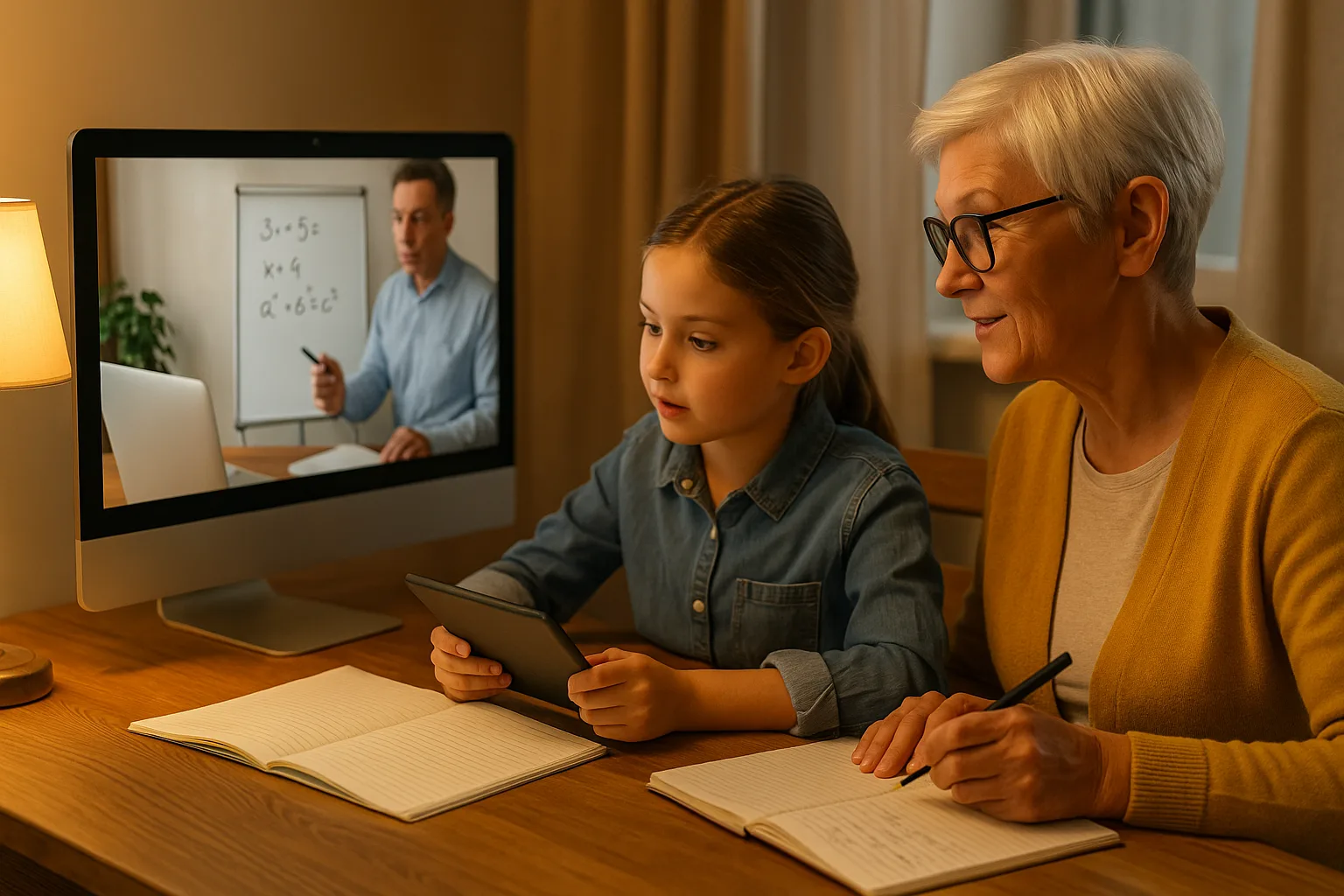
Why home-based math matters
Home is where children first meet numbers, shapes and everyday problem solving. For parents in Volgograd, turning daily routines (grocery trips, walks by the Volga, playtime) into short, playful math moments helps first- and second-graders build understanding, not just skills. The goal is to develop thinking, confidence and curiosity — through games, stories and simple experiments.
What children in grades 1–2 typically learn
Focus on concrete understanding rather than drills:
— Counting forward and backward to 100 (early grades starting to 20)
— Addition and subtraction within 20, basic strategies (doubling, making ten)
— Comparing quantities: more/less, greater/less than, equal
— Simple place value (tens and ones)
— Recognizing shapes and simple measurement (length with nonstandard units)
— Patterns and reasoning (what comes next? why?)
— Beginning work with time and money (clock basics, small purchases)
Family principles that work
— Short, frequent sessions (10–25 minutes) beat long lessons.
— Always start with concrete objects, then move to drawings and symbols.
— Use curiosity and questions: “How do you know?” “Can you show me another way?”
— Praise effort and thinking, not just right answers.
— Make mistakes okay — treat them as “math clues” to solve together.
— Use what’s around you: kitchen, market, park, public transport and toys.
Quick, ready-to-use games and activities
Materials are simple: coins, buttons, dice, paper, pencil, string, cups, toy cars.
1. Number scavenger hunt (indoors/outdoors)
— Hide 1–20 number cards around the apartment or yard.
— Child finds and orders them; for older first-graders ask to find “a number between 7 and 12” or “a number that’s 2 more than 9.”
2. Grocery store math (real-world shopping)
— Give your child a small “budget” (e.g., 50–100 rubles in play money).
— Let them pick items, add prices, and check change. Practice addition and subtraction in context.
3. Domino addition
— Place two dominoes, add the pips on one side; child writes or says the sum. Use pairs to make sums up to 12–20.
4. Dice roll race
— Each player rolls a die, moves that many steps on a path, and adds their roll to their total. First to 30 wins. Practice cumulative addition.
5. Pattern bracelets
— Use colored beads or pasta dyed with paint to create repeating patterns (AB, AAB, ABC). Ask child to continue or create their own.
6. Measurement with footsteps
— Mark start and finish in a park or hallway. Count how many of your child’s footsteps long the distance is; compare to yours.
7. Build-and-compare towers
— Use blocks to build towers of certain heights. Ask which is taller/shorter and by how many blocks.
8. Time-telling craft
— Make a paper clock with movable hands. Practice hour and half-hour: “What time will it be in one hour?”
Sample 20–25 minute lesson (Addition within 20)
Goal: add two numbers to make sums within 20 using concrete objects.
1. Warm-up (3 min): Count aloud by tens and ones to 20.
2. Introduce (2 min): Present two piles of buttons (e.g., 8 and 5).
3. Concrete practice (8 min): Child counts each pile, then combines and counts total. Repeat with 4–5 different pairs.
4. Strategy talk (5 min): Ask: “How can we make ten first?” Show making 10 + remaining. Encourage different strategies (counting on, making ten).
5. Quick game (5 min): Roll two dice and add; write sums on paper. Celebrate progress.
Materials: buttons, dice, paper, pencil. Keep explanations short and let the child show methods.
Dealing with resistance and low attention
— Follow the child’s energy: if restless, switch to a physical math game (walk-and-count).
— Offer choices: “Do you want domino addition or the grocery game?”
— Use small rewards like stickers or a positive note for the fridge.
— Stay calm — turn frustration into a short break and return later.
Tips for talking about math
— Use everyday language: “How many?”, “How much longer?”, “Which is heavier?”
— Ask open questions: “Can you show another way?” “Why did you do that?”
— Describe the thinking: “I like how you counted by twos — that’s a fast way!”
Local resources and community support in Volgograd
— Libraries, school teachers and community centers often host activities — ask your child’s school or local library about reading/math clubs.
— Use local places for math outings: markets for money practice, parks along the Volga for measurement walks, playgrounds for counting and estimation games.
— Join parent groups on social media (local VK or Telegram communities) to swap ideas, secondhand materials and organize playdates with math games.
— If you want extra help, look for tutors or small group classes in your district; ask other parents or teachers for recommendations.
A simple weekly plan (15–20 minutes daily)
— Monday: Number games — counting scavenger hunt
— Tuesday: Addition practice — dice roll race or button sums
— Wednesday: Pattern and shapes — bracelet or drawing shapes
— Thursday: Measurement — footsteps or kitchen cup measures
— Friday: Real-life math — small shopping role-play
— Weekend: Family math outing — park walk, market, or a board game night